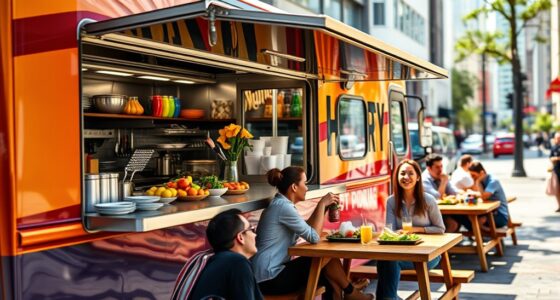

To create a food truck business plan template, start by defining your concept, mission, and target market. Conduct industry research to understand competitors and location opportunities. Outline your menu, sourcing strategies, and marketing plans to attract customers. Prepare detailed financial projections and identify funding needs. Select prime locations and operational schedules. Continuously refine your plan based on feedback and market insights. If you keep exploring, you’ll find more tips to craft a successful, adaptable business plan.
Key Takeaways
- Outline your business mission, vision, target market, and unique selling propositions to define your brand identity.
- Include detailed sections on menu development, sourcing, pricing strategies, and customer engagement plans.
- Develop financial projections covering startup costs, operating expenses, revenue forecasts, and break-even analysis.
- Identify ideal locations, operational hours, staffing plans, and compliance with local regulations for site selection.
- Incorporate marketing, growth strategies, and methods for ongoing market monitoring and adapting to industry trends.
Define Your Business Concept and Objectives

To successfully launch your food truck, you need to clearly define your business concept and objectives. Start by establishing your mission, which highlights your core purpose, such as serving fresh sandwiches or catering to specific dietary needs. Your vision should describe the long-term impact you want to have on customers, like building a loyal local following or creating memorable culinary experiences. Clarify your business concept by specifying the type of cuisine, menu offerings, and signature dishes that set you apart. Consider your ideal location—food truck pods, busy streets, or near gyms—and identify your target customers. Additionally, setting specific measurable goals for sales, growth, and brand recognition that align with your mission and vision can help you track progress effectively and stay focused on your objectives. Understanding the filtering and pump protection in your equipment can also ensure smooth operations and consistent quality as your business grows.
Conduct Market Research and Analyze the Industry

Understanding the market landscape is essential for shaping a successful food truck business. The industry is rapidly growing, with U.S. revenue reaching around $2.4 to $2.8 billion in 2025 and a CAGR of roughly 13.2%. Globally, the market is valued at about $4.9 billion in 2024, projected to hit $8.78 billion by 2033. Over 48,000 to 58,000 trucks operate nationwide, mainly in urban hotspots like California. Key growth drivers include urbanization, changing consumer tastes, and the mobility advantage over traditional restaurants. Market expansion is driven by low startup costs and rising demand for quality, convenient street food. Understanding these trends helps identify opportunities, target underserved segments, and position your food truck effectively within this competitive landscape.
Outline Your Company Details and Legal Structure

Start by choosing a memorable business name and developing your branding to stand out. Then, determine the best legal structure for your food truck, considering licenses and permits required in your location. Legal structure options include sole proprietorship, partnership, LLC, or corporation, each with different implications for liability and taxes. Finally, explain your location choices and how they support your target market and business goals.
Business Naming and Branding
Choosing the right name and brand identity is essential for your food truck’s success, as it instantly communicates your cuisine and personality to potential customers. Your name should clearly reflect your food offerings, using puns, regional identifiers, or thematic elements to make it memorable and engaging. Keep it short, simple, and easy to spell for quick recognition. Select a name that evokes positive emotions and stands out in a crowded market, supporting brand recall and customer loyalty. Guarantee the name aligns with your visual branding, including logo, color schemes, and fonts, to create a cohesive look. Before finalizing, verify its availability for trademarks, domain, and social media. Your brand identity should also reflect your values, target audience, and unique selling points to build a strong foundation. A memorable name can significantly influence customer perception and can help you establish a distinctive presence in the competitive food truck industry. Additionally, understanding the importance of AI ethics can inform how you develop your branding to resonate ethically and authentically with your community.
Legal Formation and Licenses
Establishing a solid legal foundation is essential before launching your food truck business. You need to choose a legal structure that fits your needs, such as an LLC or sole proprietorship, for liability protection and tax benefits. Register your business name with the relevant authorities, like the Florida Department of State, to secure your branding rights. Obtain an EIN from the IRS for tax purposes and open a business bank account. You must also register with the Florida Department of Revenue to handle sales tax collection. Additionally, make certain you acquire the necessary licenses and permits, including a general business license, mobile food establishment license, and health permits. These steps guarantee your food truck operates legally, safely, and ready to serve customers confidently. Registering with the Florida Department of Agriculture ensures compliance with food safety regulations specific to Florida. Understanding food safety regulations and how they apply to mobile food vendors is crucial for maintaining high standards and avoiding penalties.
Location Selection Rationale
Selecting the right location is essential for your food truck’s success, as it directly impacts visibility, foot traffic, and accessibility. You need to identify areas with high pedestrian activity, such as busy streets, parks, or transit hubs, where your target customers frequent. Observe traffic patterns during different times and days to pinpoint peak periods. Confirm your truck is easily accessible with safe parking spots and close to public transportation to boost convenience. Survey the competition to find gaps or underserved niches. Also, verify local regulations and zoning laws to avoid restricted zones or permit issues. Prioritize locations with clear sightlines and high visibility, and consider event calendars to maximize exposure. Using foot traffic data can help you choose optimal spots for your business. A strategic location sets the foundation for steady customer flow and business growth. Being aware of toilet maintenance and ensuring proper sanitation facilities nearby can also enhance customer satisfaction and compliance with health regulations.
Develop Your Menu and Product Offerings
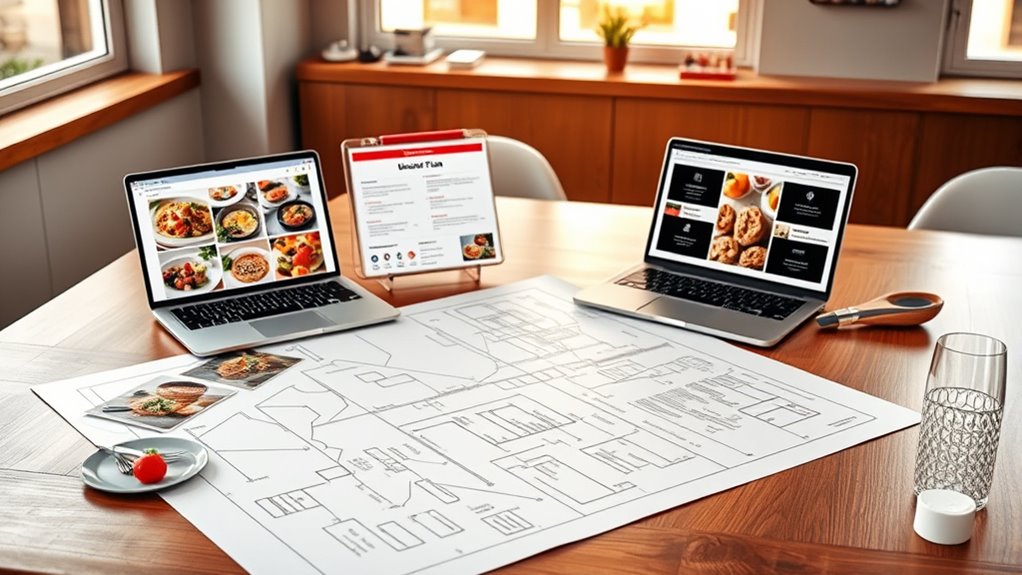
You need a clear menu design strategy that reflects local tastes and current food trends, while keeping it simple enough to streamline prep and control costs. Focus on signature dishes and popular items like tacos or burgers to stand out and attract a broad audience. Also, consider sourcing ingredients efficiently to maintain quality without overspending. Incorporating insights from glamping can inspire innovative presentation and unique offerings that appeal to a diverse customer base. Pricing strategies play a crucial role in optimizing your menu’s profitability and ensuring your offerings meet customer expectations.
Menu Design Strategies
Designing your menu involves more than just listing dishes; it requires strategic choices that highlight your unique offerings while maximizing profitability. Focus on a few standout items to streamline operations and prevent overwhelming customers. Include vegetarian, vegan, and gluten-free options to appeal to diverse dietary needs and attract a broader audience. Embrace current food trends like international street foods and fusion cuisine to differentiate your truck. Use high-quality, fresh ingredients to justify premium prices and boost appeal. Emphasize signature dishes to build a memorable brand identity and encourage repeat visits. Consider these strategies: A well-curated menu attracts new customers and retains regulars, highlighting high-margin or popular items prominently. Use vivid, sensory-rich descriptions to stimulate appetite. Incorporate storytelling to add cultural or preparation details. Design digital menus for quick updates and visual appeal. Balance menu variety with simplicity for efficient service. Additionally, understanding menu design strategies can help you create a cohesive and appealing selection that enhances customer satisfaction and profitability.
Ingredient Sourcing Options
Choosing the right ingredient sources directly impacts your menu’s quality, consistency, and cost management. You’ll need to balance local suppliers, who offer fresher ingredients and support a healthier image, with national suppliers that provide reliable volume and lower prices. Seasonal availability affects both options, so planning for menu flexibility is key. Local sourcing can reduce transportation costs but may lead to higher prices, while national suppliers ensure steady supply but might sacrifice freshness. To control costs, track ingredient usage, waste, and spoilage carefully, and consider swapping seasonal or less expensive items to save 15%-30%. Using technology, like POS and inventory systems, helps forecast needs, reduce waste, and optimize sourcing decisions, ensuring your menu remains high-quality and profitable. Additionally, understanding supplier reliability is crucial in maintaining a consistent supply chain to meet customer expectations.
Create a Marketing and Sales Strategy

Developing a strong marketing and sales strategy is essential for attracting and retaining customers for your food truck. To succeed, focus on understanding your target audience, especially Millennials and Gen Z, who value variety, sustainability, and experience. Use social media platforms like Facebook and Instagram to boost visibility, as 75% of food trucks rely heavily on them. Participate in local events and festivals to increase brand awareness and engage directly with customers. Implement loyalty and email marketing programs to encourage repeat visits—over half of food trucks see a 30% boost from these efforts. Additionally, leverage technology tools such as GPS tracking and data analytics to optimize marketing efforts and improve ROI. Over 24,000 food trucks operate in the United States as of 2023, which demonstrates a competitive landscape that requires strategic digital marketing to stand out. Incorporating insights from juice cleansing trends can also appeal to health-conscious customers seeking nutritious options. This integrated approach will help you build a loyal customer base and grow your business effectively.
Prepare Financial Projections and Budgeting

How can you guarantee your food truck remains financially viable? The key is preparing accurate financial projections and a solid budget. Start by estimating daily customer volume for weekdays and weekends to capture sales variability. Determine your average spend per customer based on menu prices and sales mix. Include multiple revenue streams like food, drinks, catering, and events. Project monthly and yearly growth considering seasonal trends. Categorize expenses into fixed costs—rent, licenses, insurance—and variable costs—ingredients, fuel, wages. Regularly update your revenue and expense forecasts to reflect actual performance. Develop monthly cash flow statements to track inflows and outflows, ensuring enough liquidity. Use profit and loss projections to identify profit margins, and calculate your break-even point to set realistic sales goals. Accurate financial projections are essential for securing funding and making informed business decisions. Additionally, understanding AI-driven financial tools can further improve forecasting accuracy and operational efficiency.
Identify Funding Options and Investment Needs

Securing adequate funding is a vital step in turning your food truck vision into reality. You’ll need to evaluate various sources to cover costs like truck purchase, equipment, permits, and marketing. Consider these options:
- Personal savings, often the initial capital for entrepreneurs
- Small business loans from banks or credit unions, requiring good credit
- Microloans from non-profits or specialized lenders for smaller amounts
- Investors or partners offering capital in exchange for equity
- Crowdfunding platforms to raise funds from community supporters
Your investment needs depend on factors like truck type, equipment, branding, and operational expenses. Planning a flexible funding mix can reduce risks, while contingency funds help manage unexpected costs. Researching local grant programs can also provide additional financial support for new small businesses. Understanding financial planning and budgeting techniques is essential for maintaining your business’s health as it grows. Align your funding strategy with your growth plans and local regulatory requirements.
Set Operational Plans and Site Selection

Setting up your food truck’s daily operations and choosing the right locations are crucial steps to guarantee consistent sales and smooth service. You’ll need to set clear operating hours based on customer flow, like lunch and dinner peaks or evening events. Assign roles such as chef/operator, cooks, and servers to streamline workflow. Develop an operational workflow covering food prep, order taking, serving, and cleaning to keep things running efficiently. Create a staffing plan with the right number of employees, shifts, and backup coverage for demand fluctuations. Research high-traffic spots like business districts, parks, or festivals, ensuring you meet local regulations and permit requirements. Evaluate site accessibility, parking, and competition, and consider multiple locations or event participation to maximize visibility and sales. Regularly monitoring sales data and customer feedback helps optimize location choices and operational efficiency. Incorporating a cohesive operational plan ensures that daily tasks are clearly defined, preventing confusion during busy hours.
Review and Refine Your Business Plan for Success

Regularly reviewing and refining your business plan is essential for long-term success because it allows you to stay aligned with changing market conditions and operational realities. By doing so, you can identify weaknesses early and adapt strategies accordingly. Focus on:
- Updating financial projections with current sales and expense data to improve accuracy.
- Incorporating customer feedback to refine your menu and increase retention.
- Monitoring competition and saturation levels to adjust marketing tactics.
- Analyzing operational efficiency to optimize service times and costs.
- Leveraging data analytics for better resource allocation and marketing effectiveness.
- Maintaining accurate financial ratios ensures ongoing financial stability and supports growth initiatives.
- Additionally, regularly reviewing market trends helps you anticipate shifts in customer preferences and adapt your offerings proactively.
This ongoing process helps ensure your food truck remains profitable, competitive, and attractive to investors. Staying proactive with your plan improves your chances of reaching break-even quickly and sustaining long-term growth.
Frequently Asked Questions
How Do I Choose the Best Location for My Food Truck?
Choosing the best food truck location is like finding a needle in a haystack—you need to know where the crowd gathers. Visit busy spots like downtown or parks during peak hours, and check local rules to avoid fines. Look for easy access, good visibility, and less competition. Conduct foot traffic studies and explore underserved markets. Your goal: locate where customers naturally flow and feel comfortable stopping by.
What Permits and Licenses Are Required to Start?
You need to secure several permits and licenses to start your food truck business. First, get a city-issued food truck permit and occupational license. Then, obtain health department permits and food handler’s certificates to meet safety standards. Make sure your truck is licensed and insured, and if required, complete food safety courses. Finally, gather liability insurance and any additional permits like fire safety or special location approvals to operate legally.
How Can I Effectively Price My Menu Items?
Imagine selling a burger that costs $2 in ingredients. To price it effectively, you could use cost-plus pricing, marking up by 150%, setting the price at $5. This guarantees coverage of ingredients, labor, and other costs while maintaining profit. You can also monitor competitor prices or use value-based strategies. Regularly reviewing costs and market conditions helps keep your prices competitive and profitable.
What Are the Common Challenges Faced by Food Truck Startups?
You’ll face several challenges when starting a food truck. Regulatory hurdles require multiple permits, which can be costly and time-consuming, risking fines or shutdowns if you don’t comply. Managing operational costs like vehicle maintenance, fuel, and inventory can squeeze your margins. Finding prime locations is tough due to high competition and restrictions. Finally, sourcing quality ingredients and hiring skilled staff pose ongoing logistical and staffing challenges that demand strategic planning and adaptability.
How Do I Develop a Compelling Brand Identity?
Imagine your food truck’s brand as a vibrant tapestry, woven with your passions and values. To develop a compelling identity, you must craft a story that resonates, choose visuals that stand out like a beacon, and define a voice that speaks directly to your audience. Consistency is key—align your messaging and visuals across every touchpoint, transforming your truck into a memorable experience customers trust and love.
Conclusion
Creating a food truck business plan is like assembling a puzzle—you need each piece to fit perfectly. By following these steps, you’ll have a clear roadmap to turn your tasty ideas into a thriving mobile eatery. Stay focused, adapt as needed, and keep your passion fueled. With dedication, your food truck can roll out just like a well-oiled machine, serving up success one delicious meal at a time.