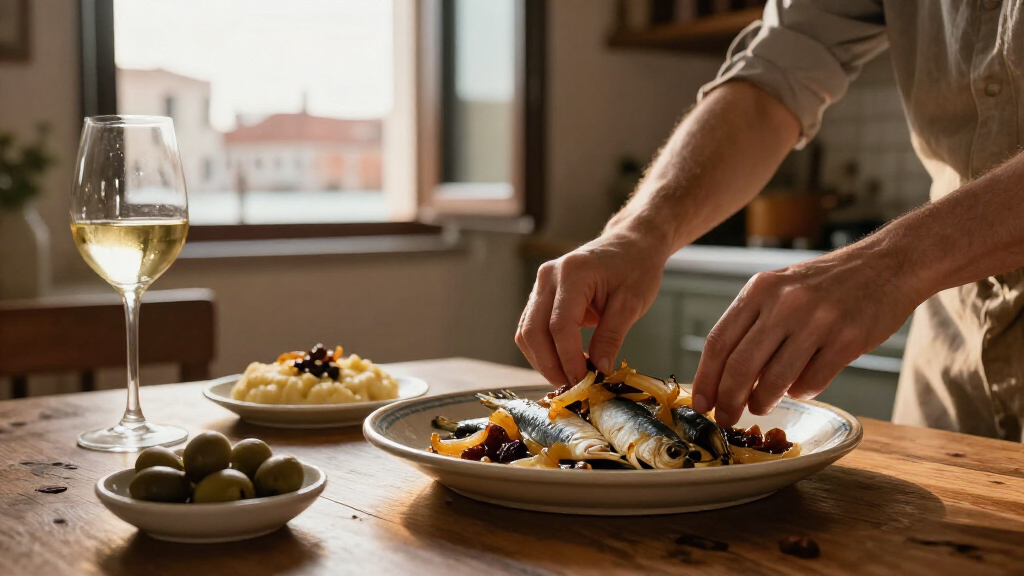

🔍 Read the full analysis: Sarde In Saor: Sweet-Sour Sardines For The Venetian Antipasto Board on Mad Tasting

Get kitchen staples and gadgets delivered free with Prime
- Fast, free delivery on millions of items
- Prime Video, Amazon Music and more included
- Member-only deals all year
TL;DR
Sarde in saor is a traditional Venetian preparation of fried sardines layered with onions cooked in vinegar, often with raisins and pine nuts. Mad Tasting recommends making it a day ahead, refrigerating it overnight, and serving it cool or at room temperature with polenta or crusty bread.
Mad Tasting’s guide to sarde in saor explains how to prepare the Venetian dish of fried sardines layered with vinegar-seasoned onions, commonly with raisins and pine nuts. It recommends making the dish a day ahead and refrigerating it overnight, then serving it cool or at room temperature as part of an antipasto board with polenta or crusty bread.
The dish combines fried sardines, soft onions, and vinegar. The onions supply mellow sweetness, the vinegar adds tang, and the fish gives the preparation a rich, savory base. Raisins and pine nuts are common additions, though recipes vary. The guide says the aim is a balanced sweet-sour flavor, not a result that tastes like candy or strongly like pickle brine.
For the method described, cooks clean and butterfly whole small sardines, pat them dry, and fry them until cooked through and golden. Fillets can also be used, but they are more delicate to turn and layer. Separately, sliced onions are cooked slowly in olive oil until soft; vinegar is stirred in and tasted before the mixture is layered with the fish. Raisins and pine nuts can be added according to preference.
Mad Tasting advises cooling the prepared dish promptly, covering it, and keeping it refrigerated overnight. The rest allows the onion mixture to season the fish, while refrigeration is necessary for safe storage: vinegar does not replace chilling cooked fish. The dish is served cool or brought toward room temperature, with bread or polenta as accompaniments.
Sarde in Saor A Venetian Antipasto
Fried sardines layered with vinegar-seasoned onions make a sweet-sour dish designed to be prepared ahead and served cool.
What goes into it
The core preparation pairs sardines with soft onions and vinegar; recipes vary.
Sardines
Fried whole small fish or more delicate fillets give the dish its savory base.
Onions and vinegar
Slow-cooked onions bring mellow sweetness; vinegar adds tang.
Raisins and pine nuts
Common additions bring extra sweetness and texture, but are not essential.
Make ahead, keep chilled
The overnight rest lets the onion mixture season the fish.
Fry the sardines until golden; cook sliced onions slowly until soft, then stir in vinegar.
Layer the fish and onions, cool promptly, cover, and refrigerate overnight.
Bring toward room temperature and serve with polenta or crusty bread.
A Venetian board with a practical twist
The guide links the dish broadly to Venetian seafaring history and cucina povera; its precise origins are unclear.
- Prepare the dish ahead for a planned meal.
- Serve without reheating the fish.
- Enjoy tangy onions with rich, savory sardines.
- Pair with simple bread or polenta.
Keep the balance
Taste the onion mixture before layering; it should be distinctly tangy without overwhelming the fish.
A Make-Ahead Antipasto With Venetian Roots
The guide presents sarde in saor as a way to make a modest fish the centerpiece of a small antipasto spread. Its make-ahead preparation can also suit a meal planned for the following day: the cook completes the layering in advance, stores it safely, and serves it without needing to reheat the fish.
The combination of tangy onions, oily fish, and optional sweet and nutty additions gives the board contrasting flavors and textures. For hosts, the practical point is that the dish can be prepared ahead while remaining part of a larger spread; for diners, the preparation offers a recognizable Venetian specialty in a serving style that works with simple sides.
Products Worth Considering

Vitamix 5-Speed Immersion Blender, 625-Watt, Stainless Steel/Black

Cuisinart 7-in-1 Air Fryer Toaster Oven, 1800W

Ninja Luxe Café Pro 4-in-1 Espresso, Drip Coffee, and Cold Brew Machine
As an affiliate, we earn on qualifying purchases.
The Saor Onion Mixture
Mad Tasting describes saor as a Venetian-dialect term associated with flavor or savoring. In the dish, it refers to the seasoned onion mixture rather than serving as a literal name for a sweet-and-sour sauce. Recipes commonly center on onions and vinegar, with raisins and pine nuts included in many versions but not treated as essential to every recipe.
The guide connects the preparation with Venice’s seafaring history and the practical use of vinegar before refrigeration. It also places the dish within cucina povera, a tradition of making satisfying food from humble ingredients. Those points are historical context supplied by the source; the precise origin of each version is not established, and the guide does not identify a specific inventor or event behind the recipe.
““Vinegar gives flavor, but it does not replace safe refrigeration for cooked fish.””
— Mad Tasting
Recipe Variations and Origins
The source does not specify a single definitive recipe, ingredient ratio, frying temperature, or cooking time. It notes that raisins and pine nuts are common but optional, and that cooks may use whole sardines or fillets. The precise history of the dish’s development is also unclear; the guide links it broadly to Venetian maritime life but does not establish who created it or when.
No particular seafood sustainability recommendation is given. The guide advises choosing sardines that smell fresh and clean and following current local seafood guidance, which can change. Its storage advice is to cool the finished dish promptly and refrigerate it covered; it does not provide a specific refrigerator temperature or a maximum storage period.
Prepare, Chill, Then Serve
For a planned meal, the next steps are to cook the sardines and onions, layer them in a covered container, and refrigerate the dish overnight. Before serving, bring it toward room temperature without leaving it unrefrigerated for an extended period. Set it out with polenta or crusty bread, and let guests choose whether they want the optional raisins and pine nuts in their portion.
The source offers a cooking guide rather than reporting a scheduled event or an upcoming announcement. Its practical takeaway is to taste the onion mixture before layering: it should be distinctly tangy without overwhelming the fish. Keep the onions at a moderate heat so they soften rather than scorch, and handle cooked sardines gently during assembly.
Key Questions
What is sarde in saor?
It is a Venetian preparation of fried sardines layered with onions cooked in vinegar. Raisins and pine nuts are common additions, but recipes differ.
Why should the dish rest overnight?
The overnight rest gives the vinegar-seasoned onions time to flavor the fried fish. Mad Tasting recommends keeping the covered dish in the refrigerator during that time.
How is sarde in saor served?
It is served cool or at room temperature. The guide suggests polenta or crusty bread and placing it on an antipasto board.
Are raisins and pine nuts required?
No. The source describes them as frequent additions, while the core preparation is sardines, onions, and vinegar. Their use depends on the recipe and the cook’s preference.
Does the vinegar make the sardines safe to store without refrigeration?
No. Mad Tasting says vinegar adds flavor but does not replace safe refrigeration. Cool the finished dish promptly, cover it, and refrigerate it.
Source: Mad Tasting