🔍 Read the full analysis: Pizzoccheri Della Valtellina: Buckwheat Ribbons, Cabbage, And Cheese on Mad Tasting

Get kitchen staples and gadgets delivered free with Prime
- Fast, free delivery on millions of items
- Prime Video, Amazon Music and more included
- Member-only deals all year
TL;DR
Mad Tasting has published a guide to pizzoccheri della Valtellina, the Lombardy dish of buckwheat-and-wheat pasta, potatoes, cabbage, cheese and garlic butter. It outlines traditional ingredients and home-cooking methods while noting that the usual pasta contains wheat and is not gluten-free.
Mad Tasting has published a guide to pizzoccheri della Valtellina, a traditional dish associated with Teglio and the Alpine valley of Valtellina in Lombardy. It describes the meal’s buckwheat-and-wheat ribbons, potatoes, cabbage, Valtellina Casera cheese and garlic-scented butter, and offers practical advice for making a home version.
The guide describes pizzoccheri as short, flat, sturdy pasta ribbons traditionally made from buckwheat and wheat flour. They are cooked with potatoes and cabbage, then layered with cheese and finished with butter warmed with garlic. The pasta’s firm texture helps it hold its shape among the vegetables and rich toppings.
Mad Tasting identifies Valtellina Casera DOP as the classic cheese choice and says Bitto may also be used. For a home version, it suggests a semi-hard cheese that melts well if local cheeses are unavailable, while noting that substitutions change the flavor and make the dish a variation rather than an exact regional-style preparation. Savoy cabbage is presented as a familiar choice; other cabbage or leafy greens can be used, with cooking time adjusted so tender greens do not overcook.
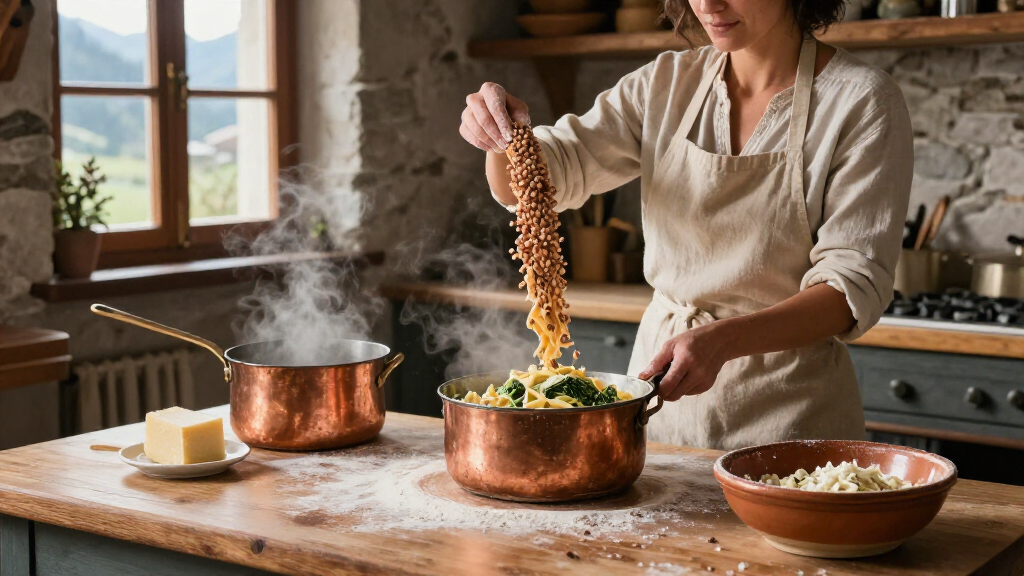
For cooking, the guide recommends adding the vegetables and pasta in stages according to how long each takes to soften, then draining them well and assembling the layers while hot. That helps the cheese soften among the ingredients. Fresh and dried pasta may cook at different speeds, so it advises following package directions for dried pizzoccheri. The guide also cautions that traditional buckwheat-and-wheat pasta contains gluten: buckwheat itself is a seed, but the usual recipe also includes wheat flour.
A taste of Lombardy · Regional food guide
Pizzoccheri della Valtellina: Buckwheat Ribbons, Cabbage & Cheese
A hearty Alpine dish linked to Teglio and the Valtellina valley: sturdy buckwheat-and-wheat pasta with potatoes, cabbage, local cheese and garlic-scented butter.
01 / Place & tradition
A regional dish for home cooks
Mad Tasting’s guide connects a practical home preparation with the ingredients and food traditions of Valtellina.
Pizzoccheri della Valtellina is a filling meal suited to cold-weather cooking. Short, flat ribbons made with buckwheat and wheat are cooked alongside potatoes and cabbage, then layered with cheese and finished with butter warmed with garlic.
The guide associates the dish with Teglio and describes its name as carrying an EU Protected Geographical Indication (PGI). A home-cooked bowl can follow the familiar regional style without necessarily meeting the requirements for a certified product.
02 / What goes in the bowl
A sturdy pasta, layered with comfort
The firm pasta holds its shape among the vegetables and rich toppings. Ingredient substitutions can work at home, but change the flavor and regional character.
Buckwheat + wheat
Short, flat, sturdy pasta gives the dish its distinctive character and satisfying bite.
Potatoes + cabbage
Savoy cabbage is familiar. Other cabbage or leafy greens work with cooking time adjusted to tenderness.
Casera DOP
Valtellina Casera is the classic choice; Bitto may also be used. Choose a melting semi-hard cheese for a home variation.
Garlic butter
Butter warmed with garlic is poured over the hot layers, bringing aroma and richness to the dish.
Firm and filling
Sturdy ribbons are built to hold their shape among the vegetables, cheese and butter.
Adapt with care
Packaged pasta makes the dish accessible beyond the valley; local substitutions create a variation, not an exact regional preparation.
03 / A practical cooking sequence
Cook in stages. Assemble while hot.
The aim is tender vegetables and pasta, with cheese softened through the layers and the finished dish well drained.
Check the pasta
Fresh and dried ribbons cook at different speeds. Follow the package directions for dried pizzoccheri.
Add ingredients by cooking time
Introduce potatoes, cabbage and pasta in stages so each has time to soften without overcooking tender greens.
Drain thoroughly
Good draining helps keep excess water from thinning the layers or leaving the finished dish greasy.
Layer while hot
Layer the pasta and vegetables with cheese, then finish with garlic butter so the cheese softens among the ingredients.
04 / From ingredients to serving
The flow of a good bowl
A simple sequence keeps the textures in balance and lets the cheese melt through the dish.
05 / The guide’s takeaways
Regional style, with clear limits
The article offers practical direction while leaving some specifics open: quantities, a full timing schedule and detailed PGI requirements are not included.
“A home-cooked bowl can follow the familiar regional style without being identical in every detail to a certified product.”— Mad Tasting
Adapt the ingredients for your kitchen, then check labels for dietary needs and current specifications for certification.Home-cooking note
06 / Key questions
What readers should know
A quick reference for the dish, its signature ingredients and the most important label check.
What is pizzoccheri della Valtellina?
A dish associated with Valtellina in Lombardy, made with buckwheat-and-wheat pasta ribbons, potatoes, cabbage, cheese and garlic-scented butter.
Is traditional pizzoccheri gluten-free?
No. The traditional pasta usually combines buckwheat and wheat flour. Check the ingredients and use a suitable alternative if avoiding gluten.
Which cheese is traditionally used?
Valtellina Casera DOP is the classic choice; Bitto may also be used. A melting semi-hard cheese can substitute at home with a different flavor.
How can I keep the dish from becoming greasy?
Cook ingredients in stages, drain them well and assemble while hot. Follow package directions because fresh and dried pasta cook at different speeds.
Source: Mad Tasting. Publication date, detailed quantities, full cooking schedule and complete PGI specifications were not provided in the source material.
A Regional Dish for Home Cooks
The guide matters to readers because it connects a practical recipe with its regional ingredients and origins, while clarifying which parts can be adapted at home. Its cooking advice addresses a common challenge with layered pasta dishes: getting the pasta and vegetables tender while allowing the cheese to soften without leaving the finished dish greasy.
It also provides a useful dietary clarification. The word buckwheat can lead people to assume the pasta is wheat-free, but Mad Tasting says the traditional dough usually includes wheat flour. People who need to avoid gluten should not treat the standard version as suitable; they would need to check the pasta’s ingredients and use an appropriate alternative.
Products Worth Considering

Instant Pot Duo Crisp Ultimate 6.5-Quart 13-in-1 Pressure Cooker and Air Fryer

KitchenAid Artisan Series 5-Quart Tilt-Head Stand Mixer, Dried Rose (KSM150PS)

Instant Pot InstantChill Ice Cream Maker with Rolled Ice Cream Cold Plate, 2-Pint
As an affiliate, we earn on qualifying purchases.
Teglio and Valtellina’s Food Traditions
Valtellina is an Alpine valley in Lombardy, and the guide ties the dish to Teglio, a town often described as its historic home. The ingredients make a filling meal suited to cold-weather cooking: buckwheat pasta, potatoes, cabbage, local dairy and butter. The article presents that combination as rooted in the valley’s food traditions rather than as pasta with arbitrary toppings.
The guide says the name Pizzoccheri della Valtellina has an EU Protected Geographical Indication (PGI). That designation connects a recognized product with its place of origin and production requirements. A home-cooked bowl may follow the familiar style without meeting the specifications for a certified product; the guide advises checking current product specifications and labeling rules before making claims about exact requirements.
The dish is also available beyond the valley through packaged pasta. That makes it possible to prepare at home, although the guide distinguishes a convenient home meal from eating the dish in the place and food culture with which it is associated.
““Buckwheat gives pizzoccheri its character, but traditional buckwheat-and-wheat pasta contains gluten.””
— Mad Tasting
Certification and Recipe Variations
The source material does not provide the guide’s publication date, detailed recipe quantities or a full cooking-time schedule. It also does not list the complete PGI product specification. While it describes the designation and advises readers to check current rules, the precise requirements for certified products should not be inferred from the article alone.
There is room for variation in the greens, cheese and pasta, but the guide does not claim that every substitution produces the same result as the familiar Valtellina preparation. Readers with dietary restrictions must check individual product labels, since the standard pasta described includes wheat and packaged products may differ.
Cooking and Checking Product Labels
The next step for home cooks is to choose the pasta and ingredients, check labels, and follow the package timing for dried ribbons or the shorter cooking time required by fresh pasta. Add vegetables and pasta in stages, drain them thoroughly, then layer everything while hot so the cheese softens through the dish. People seeking a certified regional product should consult current labeling and product specifications rather than relying on a home recipe.
No further announcement or scheduled development is identified in the source material. The guide’s practical takeaway is that readers can make a regional-style meal at home, while recognizing that substitutions, certification and gluten suitability depend on the specific ingredients used.
Key Questions
What is pizzoccheri della Valtellina?
It is a dish associated with Valtellina in Lombardy, made with short buckwheat-and-wheat pasta ribbons, potatoes, cabbage, cheese and garlic-scented butter.
Is traditional pizzoccheri gluten-free?
No. Mad Tasting says the traditional pasta usually combines buckwheat and wheat flour. Anyone avoiding gluten should check the ingredient label and use a suitable alternative rather than assume buckwheat pasta is wheat-free.
Which cheese is traditionally used?
The guide names Valtellina Casera DOP as the classic choice and says Bitto may also be used. A semi-hard cheese that melts well can work as a home substitute, with a different flavor.
How can I keep the finished dish from becoming greasy?
Cook the ingredients in stages, drain them well, and assemble them while hot so the cheese softens through the layers. The guide also advises following package directions because dried and fresh pasta can cook at different speeds.
Source: Mad Tasting