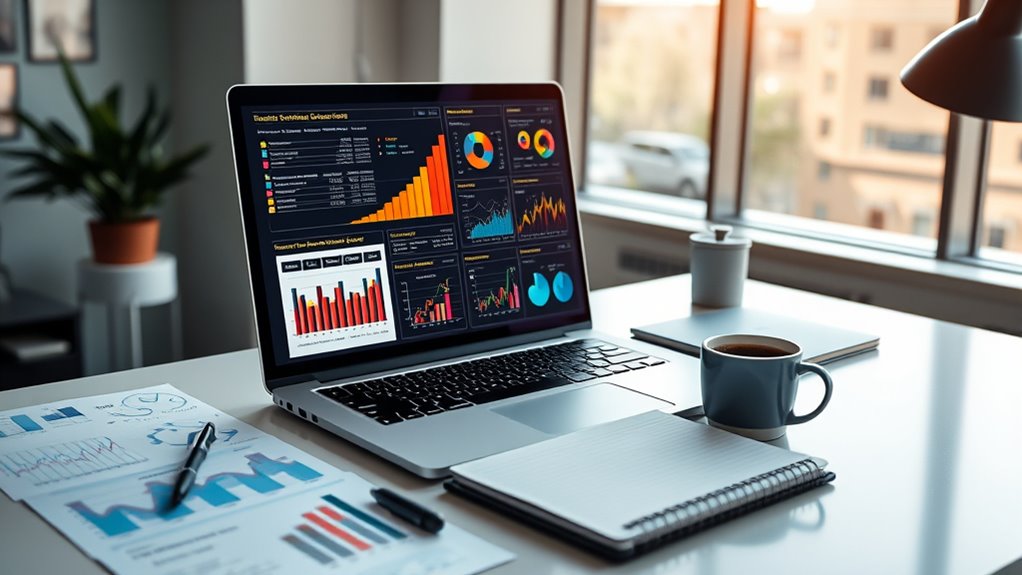

Using data analytics to refine your business plan helps you target the right market segments, understand your competitors, and spot new opportunities quickly. By analyzing real-time data from social media, purchase history, and industry reports, you can make smarter decisions, adapt to market shifts, and allocate resources effectively. Regular updates keep your strategies relevant and competitive. Keep exploring to discover how leveraging data insights can give your business a essential edge.

Get kitchen staples and gadgets delivered free with Prime
- Fast, free delivery on millions of items
- Prime Video, Amazon Music and more included
- Member-only deals all year
Key Takeaways
- Use real-time data to identify market trends and adjust your business strategies accordingly.
- Segment your target audience based on analytics to tailor marketing and product offerings effectively.
- Analyze competitors’ data to uncover market gaps and differentiate your business.
- Continuously monitor performance metrics to optimize resource allocation and improve decision-making.
- Update your business plan regularly with new insights to stay aligned with evolving customer preferences and market conditions.

Have you ever wondered how data analytics can transform your business plan? By harnessing the power of data, you can make smarter decisions, identify opportunities, and reduce risks. One of the most effective ways to do this is through market segmentation and competitive analysis. These tools help you understand your target audience better and position your business against competitors, giving you a solid foundation to refine your strategy.
Market segmentation is about dividing your broader market into smaller, more manageable groups based on shared characteristics like demographics, buying behavior, or preferences. Data analytics makes this process precise and dynamic. Instead of relying on assumptions or outdated surveys, you can analyze real-time data from various sources—social media, purchase histories, website analytics—to pinpoint exactly who your ideal customers are. This insight allows you to tailor your products, marketing messages, and sales strategies to meet the specific needs of each segment. As a result, you maximize your marketing ROI and increase customer satisfaction because you’re speaking directly to their unique desires.
Data analytics enables precise, real-time market segmentation tailored to customer needs.
Competitive analysis is equally essential. It involves examining your competitors’ strengths, weaknesses, strategies, and market positions. Data analytics enables you to gather detailed intelligence from multiple sources—public financial data, customer reviews, online mentions, and industry reports. By analyzing this information, you can identify gaps in the market, understand what your competitors are doing well, and uncover opportunities to differentiate your business. For instance, if analytics reveal that competitors are neglecting a particular customer segment or underperforming in a specific geographic area, you can adjust your business plan accordingly. This targeted approach ensures you’re not wasting resources on saturated markets or outdated strategies but instead focusing on areas with high growth potential.
Using data analytics for market segmentation and competitive analysis also keeps your business plan adaptable. Markets evolve, customer preferences shift, and competitors adapt. Regularly updating your data ensures your strategies stay relevant and competitive. You can spot emerging trends early, pivot your offerings, or refine your marketing tactics before your competitors do. This proactive approach helps you allocate resources more efficiently, set realistic goals, and develop a comprehensive understanding of the market that resonates with your target segments.
real-time social media analytics tools
As an affiliate, we earn on qualifying purchases.
As an affiliate, we earn on qualifying purchases.
Frequently Asked Questions
How Can Small Businesses Implement Data Analytics Effectively?
To implement data analytics effectively, start by analyzing customer segmentation to better understand your target audience and tailor your offerings. Use competitive benchmarking to compare your performance against rivals and identify areas for improvement. Invest in user-friendly tools and dedicate time to regularly review your data. This approach helps you make informed decisions, optimize marketing strategies, and ultimately grow your small business sustainably.
What Are the Initial Costs of Integrating Data Analytics Tools?
The initial costs of integrating data analytics tools vary, but you should budget for software licensing fees and hardware upgrades. You’ll also need to contemplate expenses related to data privacy measures to protect sensitive information. These costs can range from a few hundred to several thousand dollars, depending on your business size and needs. Planning for ongoing costs like training and maintenance ensures smooth implementation and effective use of your analytics tools.
How Do I Interpret Complex Data Reports for Decision-Making?
You interpret complex data reports by focusing on data visualization to identify trends and patterns quickly. Guarantee data accuracy first, so your decisions are reliable. Break down the reports into key metrics relevant to your goals, and ask questions about anomalies or fluctuations. Use visual tools like charts and dashboards to make insights clearer, helping you make informed, confident decisions that refine your business strategies effectively.
What Skills Are Needed to Analyze Business Data Accurately?
Ever wonder what skills help you analyze business data accurately? You need strong abilities in data cleaning to guarantee your data is accurate and reliable. Plus, data visualization skills enable you to interpret complex insights clearly. Developing an eye for patterns, understanding statistical methods, and being comfortable with analytical tools like Excel or Tableau will boost your decision-making. These skills empower you to turn raw data into actionable strategies for your business.
How Can Data Analytics Predict Future Market Trends?
You can predict future market trends through data analytics by applying predictive modeling and trend forecasting techniques. These methods analyze historical data to identify patterns and project future behaviors. By leveraging statistical algorithms and real-time data, you can anticipate shifts in customer preferences, industry changes, and economic movements. This proactive approach enables you to make informed decisions, adapt your business strategies, and stay ahead of competitors in an evolving marketplace.
As an affiliate, we earn on qualifying purchases.
Conclusion
Think of your business plan as a ship steering uncharted waters. Data analytics is your trusty compass, guiding you through storms and calm seas alike. By harnessing insights, you steer confidently toward success, avoiding hidden rocks and missed opportunities. With this powerful tool, you’re not just drifting; you’re charting a course with purpose. Embrace data analytics, and your business voyage becomes a journey of discovery and growth.
As an affiliate, we earn on qualifying purchases.
business performance metrics dashboard
As an affiliate, we earn on qualifying purchases.
As an affiliate, we earn on qualifying purchases.
NFL season / tailgating Picks
team gear
As an affiliate, we earn on qualifying purchases.